Thursday, November 30, 2006

Africa's Obesity Problem

When we think about Africa and food, we think about the starving and malnourished children in the country. In a recent AP article, researchers have estimated that 1/3 of African women and 1/4 of African men are now considered overweight. Another problem that correlates with this is the cultural tradition of Africans who see being overweight as a sign of prosperity. And the thought of going on a diet to lose the weight is not something the population chooses to do.

"Here, if you lose a lot of weight, people automatically think you have TB or
AIDS. It's not like in America and Europe where you go on a diet to lose
weight," Njobo said.


In South Africa, overweight or obese women count for 56% of the population, while the amount of undernourished is only 10%.

On top of all of this, many of the rich don't believe they should sweat, so they don't exercise. Others don't walk in their neighborhood because they don't feel safe.

There is a lot happening within that country in regards to the population's health. I just hope something is done before it gets out of hand.

Tuesday, November 28, 2006

Heart Rate Monitors

Cardiovascular training is such an important issue and I really want to discuss this topic a lot on this blog. The LA Downtown News did a story recently on Finding the Right Rate and it's great read. It may not make a lot of sense until you start learning more about heart rate and the role it has on fat loss, but I hope to share more information with you as time goes on. If you are looking for a suggestion on a heart rate monitor, I personally love my Polar s625X. I won't exercise without it. No, honestly, I will go back home and get it before I start exercising. Once you start exercising with a heart rate monitor and really understand how it works, you won't be able to function without it. Look for more articles on Cardiovascular Activity and Heart Rate Monitors in the near future.

Nintendo Wii Side Effects!!!


This is a warning to the general public that the new Nintendo Wii, could result in your kids getting off the couch and exercising! Psss, they might even enjoy it too. Don't tell them it's exercise though. There's a very good chance that information could turn them off from the new Nintendo console. Sponge just published a recent story about people who have enjoyed their Wii so much that they woke up sore the next day. It's amazing to hear what a little activity will do to you. One 12 year old even went so far to say that playing one of the games was harder than playing real basketball.
I often have issues with kids that sit down all day and watch television and play video games. It's great to see something that combines the kids getting more active and still enjoying their video games. My last game system was probably the original Nintendo, but I could actually see myself enjoying this.

Triathlete Nutrition

Many athletes don't realize the importance nutrition can make when you are training for a race or competition. Triathlete Magazine recently did a great story on 2 different approaches to nutrition for a triathalon. It gives you a real eating plan, how many calories you will be consuming, how long you will be racing, and when to eat or drink each item. No matter what sport you enjoy, when you want to compete in advanced levels of athletics, you have to take nutrition seriously. Triathlete magazine did an excellent job of explaining it to triathletes.

Monday, November 27, 2006

Skiing Exercises

Getting ready for the slopes insprires a lot of people to get into the gym and start preparing for yearly skiing trip. What you may not realize is that your focus on the gym should be on endurance more than strength. Strength specialist, Scott Livingston suggest a few ski-friendly exercises.

The three exercises he recommends are the Split Squat, Ball Back Extension, and the Front to Side Plank. These are his descriptions of the exercises, and I want to include some pictures along with his words.


SPLIT SQUAT
Skiers may have a parallel stance on the hill, but in reality both legs work as one, which is why it pays to improve your single leg stance and balance while building strength in your quadriceps and hamstrings.
Start position: Stand with your back to an exercise ball and place the instep of your left foot on top of the ball. Move your front leg forward to lengthen your stance and make sure the foot is pointing forward (not angled outward). Shift your body weight over the front leg.
Action: Lower your hips until your front knee is flexed to 90 degrees. Lift the hips back up to the starting position. Lift and lower the hips a maximum of 30 times before switching legs.
Tip: If the knee of the front leg pushes ahead of the foot while lowering your hips, lengthen your stance by moving your front leg farther from the ball.


EXERCISE BALL BACK EXTENSION
The back is the first muscle group to fatigue in skiers,which is why it needs extra work to improve endurance.
Start position: Kneel behind an exercise ball and lower your upper body over the ball, looking at the floor in front of the ball. Lift your knees off the floor and roll the ball under your hips. Interlock your fingers behind your head.
Action: Keep your lower body stationary and lift your upper body off the ball. Hold for 90 seconds. Lower your upper body to the ball and repeat four more times.
Tip: Keep your head in line with the spine as you lift your upper body off the ball.

FRONT TO SIDE PLANK
The plank improves core stability, which helps skiers maintain an upright posture even during unexpected changes in terrain.
Start position: Lie on your stomach and prop your upper body off the floor by placing your weight on your forearms. Your elbows should be positioned right underneath the shoulders, with your hands pointing forward. Both feet are flexed with the toes on the floor and the heels pointing toward the ceiling.
Action: Push your body off the floor until your head, shoulders, hips, knees and heels are in a straight line. Hold for 30 to 45 seconds. Rotate your body to the side, while maintaining the plank position, supporting the weight of your upper body on one arm (legs should be stacked one on top of the other with the hips off the ground). Hold for 30 to 45 seconds.
Rotate back to the front plank position and lower your hips back to the floor. Relax for 30 seconds and repeat the manoeuvre, this time rotating the body to the other side.
Tips: Breathe normally (don't hold your breath) through all phases of the exercise. For a less challenging version of the exercise, perform the plank position from the knees, not the toes.

A New Exercise Pyramid is Coming!

Did you know that we even had an exercise pyramid? Take a look at the current exercise pyramid.

They are predicting that it will suggest 60 minutes a day for a healthy lifestyle, and 90 minutes a day to lose weight. I know most of us here this suggestion and think it's impossible, but take a look at this story.

A recently read a story entitled the Suffolk family's fitness challenge about a family in the UK that exercised 60 minutes a day. The whole point was to exercise for 10 minutes, 6 times a day, 7 days a week. They basically found a way to squeeze in one hour a day every day of the week and kept a journal of it. Some of the days it was even raining, but they still found a way to fit in 60 minutes a day of activity.

This story even inspired me to step up my program more. If this family can do it, without belonging to a gym, surely I can find a way to do it. I will keep this up. I would never ask anyone else to do something I can't do, so I'm going to try to keep it up for as long as possible.

Exercise Improves Sleep in Heavier Kids

The United Press International recently published an article entitle, "Exercise Improves Sleep in Heavier Kids". The article talks about a study that was published in the November issue of Obesity that showed that overweight kids who began exercising on a daily basis snored less after 6 months than those who did not exercise. The had kids that didn't exercise, some that exercised 20 minutes everyday, and some that exercised 40 minutes every day. The group that exercised the most saw the biggest change, the group that exercised 20 minutes saw some change, and the group that didn't exercise saw no change. They monitored snoring as a determinate factor. It turns out that kids who snore should see a physician. I did not know that honestly.

"Parents don't realize snoring is something to worry about, that it's worthy of
a physician's attention," said lead author Dr. Catherine Davis, an associate
professor of pediatrics at the Medical College of Georgia in Augusta.


So if your kid is one of the 25% who snore, you should get your kid exercising and also inform your physican about your child.

Saturday, November 25, 2006

Back Surgery vs Physical Therapy for Herniated Disk

I don't like back surgery, actually I hate back surgery. I don't use that word often, but I get so irritated with the amount of back surgeries that happen. There was an article that I remember that stated that only 1% of back pain surgeries are actually necessary. 1% Did you get that? That's frightening to me. Why are so many people having surgery, and if surgery isn't the answer, what is?

Let me cover some concrete data first. In an article recently published in the Journal of the American Medical Association. Dr. James Weinstein, a researcher at Dartmouth College and recipient of the Wiltse Lifetime Achievement Award by the International Society for the Study of the Lumbar Spine in 2006 watched 1,000 people over two years who ever had surgery or chose physical therapy. Over the 2 years time they found only a slight improvement in those who opted for the surgery for those who did not have it.

"In back surgery for this particular condition, there's actually a choice," said
lead author Dr. James Weinstein of Dartmouth Medical School. "If you don't
want the risk of surgery, you can do watchful waiting" and still get well.

I really like this surgeon. He seems to have a good handle on the benefits of surgery, but also the limitations of it. I know that surgery is sometimes crucial, but it's been abused and often just ends up hurting the patient in the long run, physically and emotionally. I cannot imagine going under the knife with the chance that I could wake up paralyzed.

Dr, Weinstein did a Q&A recently about different back pain issues that covers degenerative disks, back pain and jogging, and even the size of kids backpacks. Scroll down a little bit on the article and you can view it. It's a great read!

I'm a big believer in physical therapy. I saw my dad suffer for years after a botched surgery on a herniated disk, and the surgery should have never been performed. For 10 years my dad could not live a normal life, and as his, I couldn't have a normal dad. I know surgeries can change a life for the better as well, but I can't help but let out a big sigh of relief after seeing a surgeon state that there is little benefit after two years. I hope everyone wakes up and realizes there are other options besides surgery. You'd be amazed at how much a little physical therapy could do for you.

The Risks of Exercise?

Isn't exercise suppose to be good for you? Am I now telling you there can be bad things about exercise too? Yep. Just like everything, there is a balance that has to be maintained. Do to much, and you could find yourself in trouble. A recent article discusses the different risks associated with exercise.

"No action is without risk and exercise is no exception. For example, the
risk of sudden cardiac death increases by a factor of 5 during vigorous
exercise for fit individuals and by a factor of 56 for unfit individuals."


The article also covers the topic of exercise addiction. One great thing about the article is that it goes on to discuss some reasonable solutions for exercising. It lays out a general plan and some excellent guidelines.

Mirror Muscles

A recent article entitled Back to the Future: Get Cracking on Improving Your Vertebrae is so random it is hard to follow, but it made enough important points that I had to post it. They use one of my favorite phrases of all time, "Mirror Muscles". Mirror Muscles are those muscles that you can see when you look in the mirror. Everyone is obsessed with their chest, abs, sometimes shoulders, biceps, and quadriceps (front of the leg). They usually neglect their back, glutes (butt), triceps, and hamstrings (back of the leg). So you have someone that is very well developed in the front and the back of them is way behind. Why do people do this?

Well vanity is the number one reason I would say people do it. They want to look good, so they work on what they see. The danger in this is that it creates some serious problems long term. You eventually get to the point where you are slumping forward because of an improper balance of muscle strength throughout the body. The picture to the left isn't the best picture, but it shows what happens over time when you do have bad posture. Forward heard, rounded back, and anterior pelvic tilt. The more you sit and stand incorrectly, the more you begin looking like the picture. Once you start slumping you may experience lower back pain, upper back pain, neck pain, and/or headaches. Dealing with this condition has become a huge part of my personal training. It seems that almost everyone has a problem with this, and the more we sit in cars, or work in front of the computer with bad posture, the worse it gets. So it's not just the gym that causes it, it's also our lifestyle.

One great resource I found was an article done by the APTA (American Physical Therapy Association). They made a informational pdf resource on proper posture. Chiropractic Care can also be beneficial for posture correction. I don't have an information sheet like I had for the APTA, but Dr. Barnwell, in Katy, TX has some information on his website about posture.

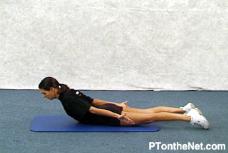
To revisit the article I first mentioned, in the article they mentioned doing 'Supermans'. I'm going to improve on that a little bit and instead mention Floor Cobras. It's a much better exercise and is easier to do correctly. (It also mentions some plyometric movements, but I don't even want to start on that topic right now.) Let me include some information on the floor cobra to help you out.

Floor Cobra (Info from ptonthenet.com)

Difficulty Level : Beginner
Muscle Group(s) : Core Back and Neck
Modality : Stability
Benefits : Core, Glutes, Middle and lower traps.
Pre-Requisites :

  1. Clients should have education in core and glute activation.


  2. Clients should be able to activate glutes, erectors and hamstrings in correct sequence.
Preparation :
  1. Laying face down on the floor-in prone position, have arms beside your hips.


  2. Activate core by drawing in navel towards spine and squeezing glutes.

Movement :

  1. With core and glutes activated, lift chest off the floor, lift arms up and back towards the hips rotating thumbs towards the ceiling.


  2. Pause momentarily at the top of the lift then return to starting position; at all times keeping the chin tucked into the chest.


  3. Upon completion of the movement, repeat.


  4. Don't over emphasize arching of the back to lift the chest off the floor. Only lift to where the client is comfortable-no lower back pain should be felt. If so check sequencing of glute, erectors and hamstrings.

Exercise Myths

10 News in San Diego recently did a story on Exercise Myths. It is a well written article that covers a great topic. They offer 5 primary tips in the article.

  1. I have to pant and sweat for a workout to count.
  2. Lifting weights will make me bulk up.
  3. I'll just work the spots that bother me.
  4. After the gym, I'll keep burning calories at home.
  5. I can't fit regular exercise into my life, so why bother at all.

Read the article for detail on these tips. Exercise Myths

Thursday, November 23, 2006

The Japan Diet

From the best-selling author of Japanese Women Don't Get Old or Fat comes a new weight loss book, The Japan Diet.

THE JAPAN DIET IN A CAPSULE:-
1. Eat more fish, especially oily fish like salmon, sardines, mackerel
and herring.

2. Eat lots more fruit and vegetables, in a rich variety of many types
and colours.

3. Japan-style your portions: enjoy moderate helpings and smaller
plates.

4. Eat mindfully – relax and eat at a leisurely pace, aim for variety,
moderation and balance.

5. Choose foods with less saturated fat, salt, added sugars, and little
or no trans fat.

6. Be gentle to your food: cook with heart-healthy oils, such as
rapeseed, and healthy techniques, such as steaming.

7. Eat more wholegrain foods like brown rice, wholegrain breads and
cereals.

8. Lighten up your beverages: drink fewer sweetened fizzy drinks and go
for unsweetened tea, water and low-fat milk.

9. Think of generous amounts of veggies more often as the star of your
meal.

10. Don’t skip meals, including breakfast.
11. Get physically active and stay active regularly: moderate exercise,
like walking, counts.

12. Think of food as a source of joy, indulgence, good health, positive
energy, laughter and celebration. Don’t go on a diet. Instead, phase healthy
eating habits into your daily diet over the long term.

Fitness Industry Pushes for Better Trainers

A recent AP story is calling for the fitness industry to push for better qualified personal trainers. Years ago the best personal trainer was the one who was the most muscular and had the best six pack, but today we have to wonder, "Can they help me with my heart disease?" As the baby boomers get older, health is more important than vanity. It may shock a lot of people to know that many of the personal trainers you encounter may have been certified through a weekend online course that took just a few hours. There are so many certifications out there that are meant to be easy, and the ones who suffer from it are the clients. The story talks about Purdue creating a personal training degree program that helps educate professional on how to be a personal trainer. It's about time, and I hope other universities follow.

I know you may be desperate to achieve results, but please research before you just hire anyone to work with you. You are making a big investment into your health, and choosing the wrong trainer could lead to an injury instead of the results you were hoping to achieve. Do your research first. You will be glad you did.

My Qualifications

Healthy Eating Tips for Children and Adolescents

A list of the top ten nutrition tips for children and adolescents was recently published on vitadidonna.it and gives some great practical advice.

Their top ten list is:
1. Enjoy your food
2. Breakfast is a very important meal
3. Eat lots of different foods
4. Base your food on carbohydrates
5. Eat fruits and vegetables at each meal
6. Fat facts
7. Snack attack
8. Quench your thirst
9. Care for your teeth
10. Get moving

Some of you may have shuddered when you read #4, but read the article for a full explanation. I really think this list applies to adults too. It's a pretty simple and straightforward list of simple things you can do to improve your health. And yes, that includes #4 too.

Wednesday, November 22, 2006

Web co. targets weight loss: Hub start-up spurs dieting

An article from the Boston Herald talks about a start-up company called Tangerine Wellness that writes programs to help your employees get in better shape. They write a custom program for the company with daily motivational e-mails to the employees and rewards employees with money as they lose weight. It's a great way to get your employees in better shape and save money on healthcare costs. A sick employee costs the company money, but motivating the employees to get in better shape, and rewarding them for accomplishing it, will make it better on your bottom line. The healthier they are, the happier they are, and the less sick days they will take, thus saving employers money. It doesn't get any better than that.

Get started today.
Tangerine Wellness

Texas Cardiovascular Health and Wellness Program

I had no idea that Texas had a Health and Wellness Program. I'm checking into it right now, hopefully I will keep this updated.

My E-mail:
I wanted to inquire about the Cardiovascular Health and Wellness Program. I honestly had no idea this existed, but it's great to see that Texas is trying to do something about the health and wellness of Texans. I live in Katy, TX, but I'm not sure there are any programs that are active here. I am a personal trainer at *edited*, and I would like to see the health of residents in my community change for the better. If the Department of Health Services has something that I can distribute to people, I would do it. I have a lot of ideas that I feel will make it easier to reach out to the community, but I don't have enough information to get it started. Is there a program Texas has created for the public that would give the residents a gameplan on how to avoid Cardiovascular disease? I was going to create one myself, but if it's already been created, it would save me a lot of time. What can I do to help your department reach out to the residents in my area?

Their Reply:
Thank you, Jason, for your interest in health. The Cardiovascular Health and Wellness Program works to promote policies and system changes within the school, worksite, healthcare and community settings that help people live heart and brain healthy lives.

There are other programs within the department that focus on reducing risk factors such as diabetes, physical inactivity, poor nutrition and tobacco use, and with our external partners, such as the American Heart Association, American Cancer Society, etc. we work collaboratively to train and provide technical assistance in implementing those policies, programs and system changes for a healthy life.

I will ask our staff person in Houston, Lois Grant, to provide you with more information about the local resources you can access and become a part of. Thanks!

Jennifer Smith, MSHP

Manager
Adult Health and Chronic Disease Group
Texas Department of State Health Services
1100 West 49th Street - T-402
Austin, Texas 78756
512-458-7111 extension 2209
512-458-7254 (Fax)
www.texascvdcouncil.org

Sunday, November 19, 2006

Small Steps

Have a big goal, and realize you have a big goal? Big goals are often overwhelming, and you have to readjust your mindset and focus on a small goal instead, suggests Madison Chase Fitness. When you focus on a small goal, you can stay more motivated than if you focus on the bigger picture. A beginning program they came up with looks like this:

Level A

Step 1: Begin by setting realistic fitness goals. (2 pounds per week)

Step 2: Find a partner who will help you meet your fitness goals. (A
positive friend, co-worker, boyfriend/ girlfriend, or spouse.

Step 3: Establish a reward that both of you are interested in.

Step 4: Set a realistic time frame to achieve your goals

Step 5: Come up with your program: (Walking 2 times per day for 30
minutes)

Step 6: Increase your fruits and vegetables and decrease your
sugar, sodium, cheese, fried foods, and juices.

Step 7: Get Started.


I think this is a great plan! It has small goals, changes in nutrition, changes in lifestyle habits, and accountability. It's very basic, but the basics are everything. For more detail visit the article.

Saturday, November 18, 2006

Fitness is a Lifestyle

Staying in shape is a lifestyle! This is a great short article on the importance of just taking it easy and not stressing over things. The personal trainers in this article say it very well, it is a lifestyle change that has to occur to get in shape. You simply want to be functional. Nothing more to it. And when that happens, you will feel better and move better, and actually be able to enjoy life.

Reversing Osteoporosis

The Bradenton Herald recently did a story entitled, "Weight-Bearing Exercise Replishes Bone Loss". It is an excellent story about how Laurie Cohen began fighting off osteoporosis at the age of 50 after having a bone scan. She began walking and taking Actonel to fight it off, with minimal success. But when she began working with a personal trainer and lifting weights, something amazing happened.

'Cohen's bone density had increased 4.4 percent in less than a year, an improvement that Dr. Kathy Diemer calls "impressive."'


She didn't lift heavy weights, in fact she wasn't using any weights over 12 pounds, but the exercise was enough to see a significant impact on her bone density.

There is never an age where it is "too late" to change your body. Never give up on yourself.

Weight Loss Supplement Ads

Calorie Lab posted a great article on supplement ads. We spend millions on weight loss supplements every year. It's good to see some truth published out there.
Great Read!

Jason Hodge

Certified Personal Trainer
Medical Exercise Specialist

Bringing over 13 years of personal training experience to the Katy, TX area, Jason Hodge strives to improve the health of local residents by helping them lose weight and eliminate pain. While Jason has numerous educational accomplishments, he feels that his greatest asset is his concern for others. Trying to lose or get out of pain is a very tough journey, physically and emotionally. It is my committment to help everyone that I can.

Jason Hodge has been featured in:

  • Katy Magazine
  • Absolutely Katy Magazine
  • Houston Chronicle
  • OnlyKaty.com
  • Freckletown.com

Jason Hodge also:

  • Has Been featured twice on a national radio show
  • Leads the Katy Chamber Health and Wellness Committee
  • 2007 Katy Sun Readers' Choice Award - Personal Trainer of the Year
  • 2008 Katy Sun Readers' Choice Award - Personal Trainer of the Year
His education experience includes:
  • Bachelors in Kinesiology
  • Coopers' Institute Certified Personal Trainer
  • NASM - Certified Personal Trainer
  • NASM - Certified Corrective Exercise Specialist
  • NASM - Certified Performance Enhancement Specialist
  • Titleist Performance Institute - Golf Fitness Instructor
  • AAHFRP - Medical Exercise Specialist
If you are looking for a personal trainer, contact me today.